That fuzzy patch of black growth behind your laundry room wall looks like a quick fix with a bottle of bleach. However, reaching for a spray bottle could be the mistake that compromises your family’s health and your home’s future resale value. Finding mold in your Mesa home triggers immediate anxiety. It’s natural to want a fast, affordable solution. You’re likely weighing the pros and cons of DIY vs professional mold remediation Mesa homeowners often face during our humid monsoon seasons.
You don’t want to overspend on a minor issue, but you can’t afford to ignore a toxic threat. This guide clarifies the critical threshold between a simple weekend cleanup and a hazardous infestation. We’ll break down the 2026 EPA safety rules regarding the ten-square-foot limit. You’ll learn the hidden risks of improper DIY methods and how to ensure your insurance carrier doesn’t deny your claim due to improper handling. We’ll provide the rule of thumb you need to protect your property’s long-term safety and your own peace of mind.
Key Takeaways
- Identify the exact 10-square-foot threshold that separates a safe weekend cleanup from a hazardous professional-grade emergency.
- Stop using bleach on porous drywall; learn why this common household tactic actually feeds mold roots and worsens the infestation.
- Compare DIY vs professional mold remediation Mesa techniques to see how industrial HEPA scrubbers prevent spores from contaminating your HVAC system.
- Secure your insurance coverage by understanding the “sudden and accidental” clause that often leads to the denial of DIY cleanup claims.
- Preserve your property’s resale value and your family’s health by identifying moisture sources that surface-level cleaning will never resolve.
The Threshold: When is DIY Mold Removal Safe for Mesa Homeowners?
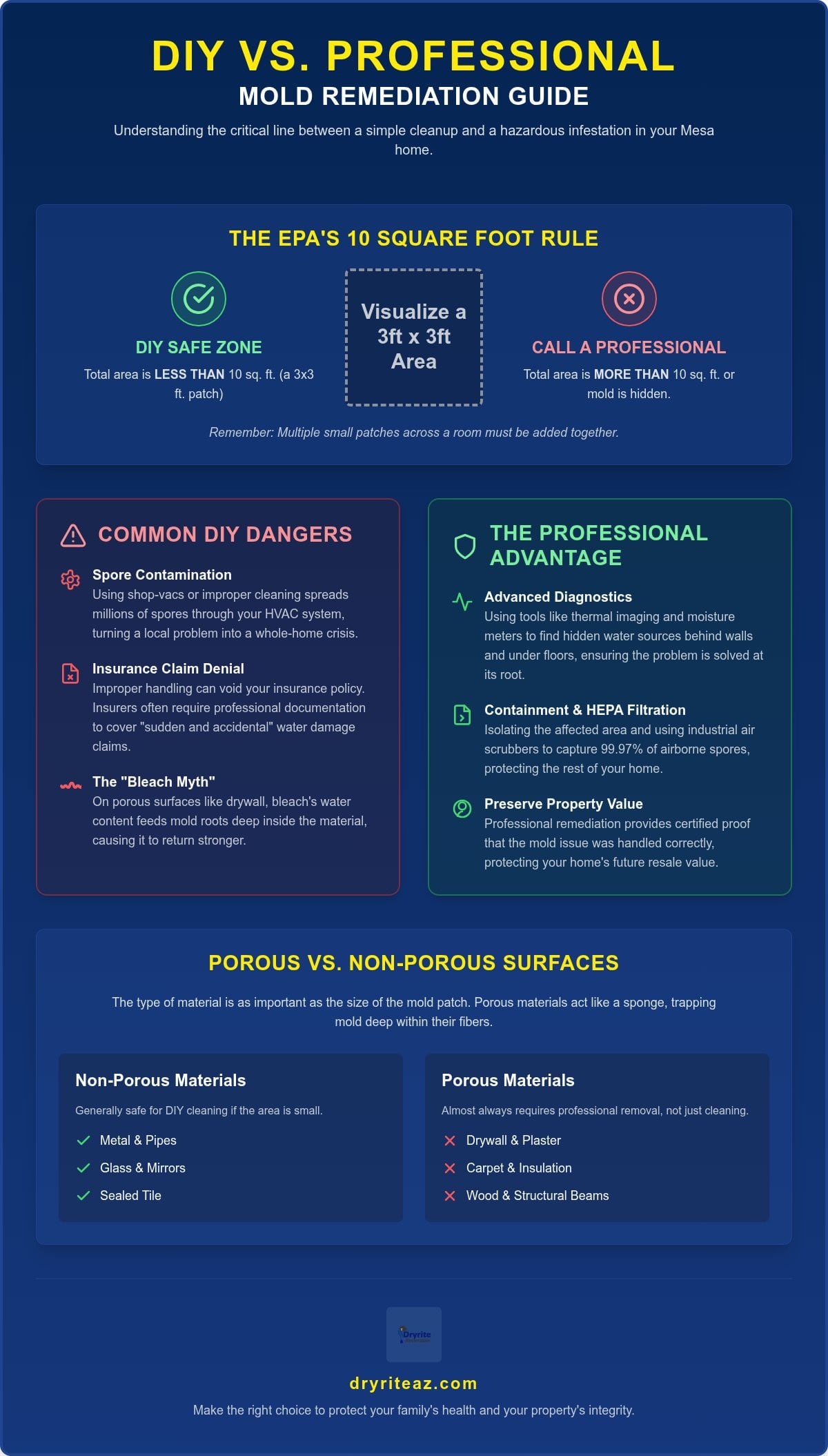
Finding a dark patch in your bathroom or laundry room is a moment of high-stakes urgency. You need to act fast to protect your family’s health and your property’s value. The Environmental Protection Agency (EPA) provides a clear guideline for this situation. DIY cleanup is generally considered safe only for areas smaller than 10 square feet. If the contamination is limited to a small, manageable patch on a hard surface, a homeowner can often handle the task. However, the decision regarding DIY vs professional mold remediation Mesa homeowners make often hinges on what they cannot see.
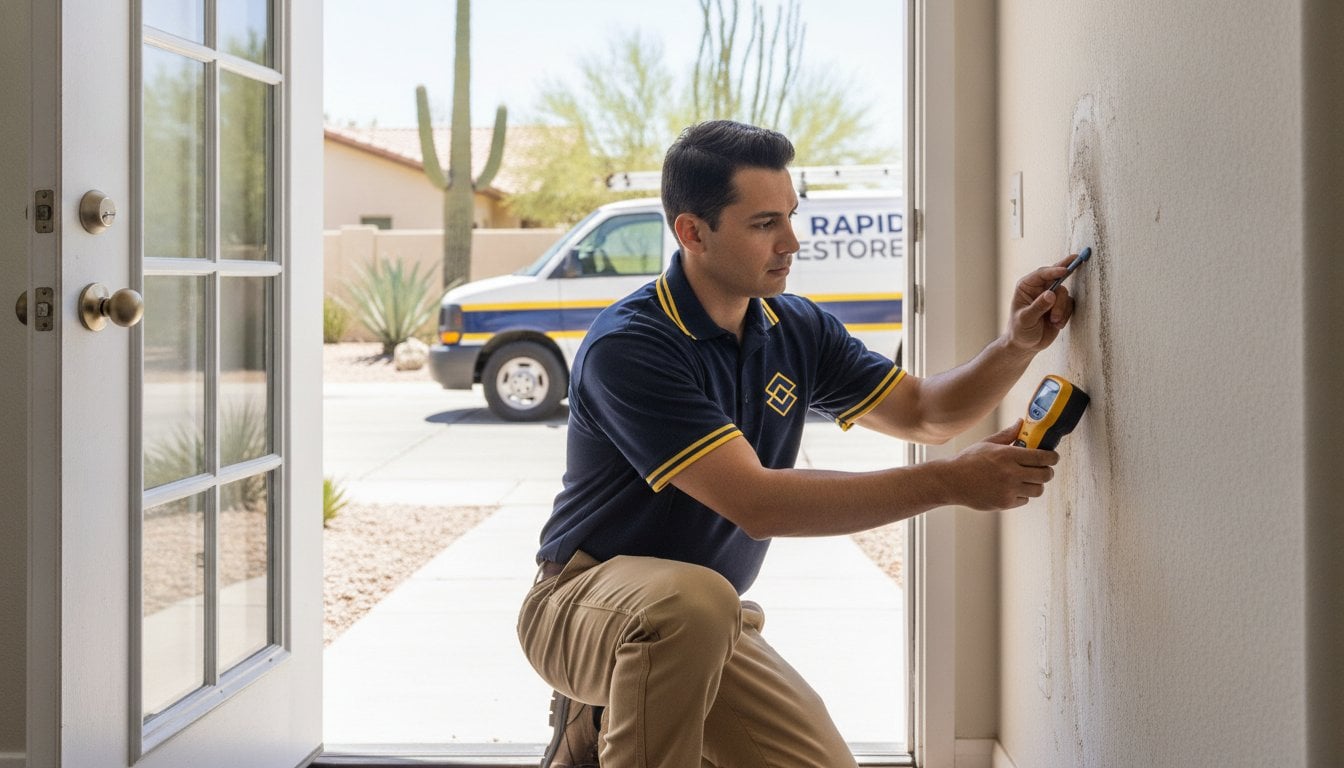
Visible mold is frequently just the tip of the iceberg. In the Phoenix Metro area, moisture often hides behind baseboards or inside wall cavities after a monsoon storm or a plumbing leak. If you detect a persistent musty odor but see no growth, don’t attempt a DIY fix. This scent indicates active colonies hidden from view. Odor without sight always requires a professional inspection to locate the moisture source before it compromises your home’s structural integrity. Surface cleaning won’t solve a problem that lives inside your walls.
Porous vs. Non-Porous Materials
The type of material matters as much as the size of the patch. Safe surfaces for DIY include:
- Metal: Pipes and fixtures can usually be scrubbed and disinfected.
- Glass: Windows and mirrors don’t absorb spores.
- Tile: Sealed ceramic surfaces are generally safe for home cleaning.
For a comprehensive overview of indoor mold and how it colonizes different environments, it’s clear that porous items usually require removal rather than cleaning. Materials like drywall, insulation, and carpeting act like sponges. They trap spores deep within their fibers where chemicals can’t reach. Structural wooden beams are particularly risky; surface scrubbing fails to reach the roots, leading to regrowth within days. If mold has reached these materials, professional extraction is the only way to ensure the infestation is gone for good.
The 10-Square-Foot Rule in Practice
To visualize the safety limit, imagine a three-foot-by-three-foot square on your wall. This is the maximum area you should attempt to clean yourself. If the total contaminated surface area exceeds 10 square feet, the risk of airborne spore release during cleaning becomes too high for household equipment to manage. Remember that multiple small patches across a single room still count as a professional-grade job because they indicate a systemic moisture issue. The DIY threshold is defined as a total contaminated surface area of less than 10 square feet on non-porous materials only. Anything beyond this requires industrial-grade containment to prevent cross-contamination.
The Risks of DIY Mold Removal in Arizona’s Unique Environment
Attempting to clean mold without professional equipment often backfires. A common mistake involves using a standard shop-vac to clear visible debris. This effectively turns the vacuum into a spore cannon; it sucks in heavy particles while exhausting millions of microscopic spores directly into your air ducts. Once these spores enter your HVAC system, they circulate throughout your entire home. This cross-contamination transforms a localized issue into a whole-house crisis that requires much more invasive repairs.
Many people rely on the “Bleach Myth” for cleanup. Bleach is designed for non-porous surfaces like tile or glass. On Arizona’s common porous drywall, bleach cannot penetrate deep enough to kill the mold’s roots. The chlorine stays on the surface while the water in the bleach soaks into the wall. This actually feeds the mold. It creates a cycle where the growth disappears for a week only to return stronger and deeper. Inadequate drying after these DIY attempts leads to structural rot hidden behind a fresh coat of paint.
The Monsoon Moisture Paradox
Mesa’s climate shifts dramatically between July and September. While we live in a desert, the monsoon humidity creates a pressure cooker environment inside wall cavities. DIY attempts often fail to address the moisture trapped behind paint or under flooring. This hidden dampness leads to structural rot that compromises your home’s stability. We use specialized tools to find what the human eye misses. You can read our thermal imaging leak detection article to see how we pinpoint moisture pockets without tearing down your walls. Understanding the nuance of DIY vs professional mold remediation Mesa weather patterns is the only way to ensure the bloom doesn’t return during the next storm cycle.
Health Hazards and Toxic Spores
Mold is more than a simple allergen; certain species produce mycotoxins. These chemical compounds can cause neurological issues and severe respiratory distress. Disturbing a colony without a sealed environment releases these toxins into your breathing zone immediately. While many homeowners use N95 masks, they often lack the fit-test or full-body protection required for high-density growth. Following EPA guidelines on mold cleanup is a good start, but it doesn’t replace the safety of industrial containment. Professional containment prevents spore travel to clean rooms. If you’re worried about potential exposure, it’s safer to have a specialist evaluate the situation before you start scrubbing.
The Professional Advantage: Why Remediation is a Strategic Investment
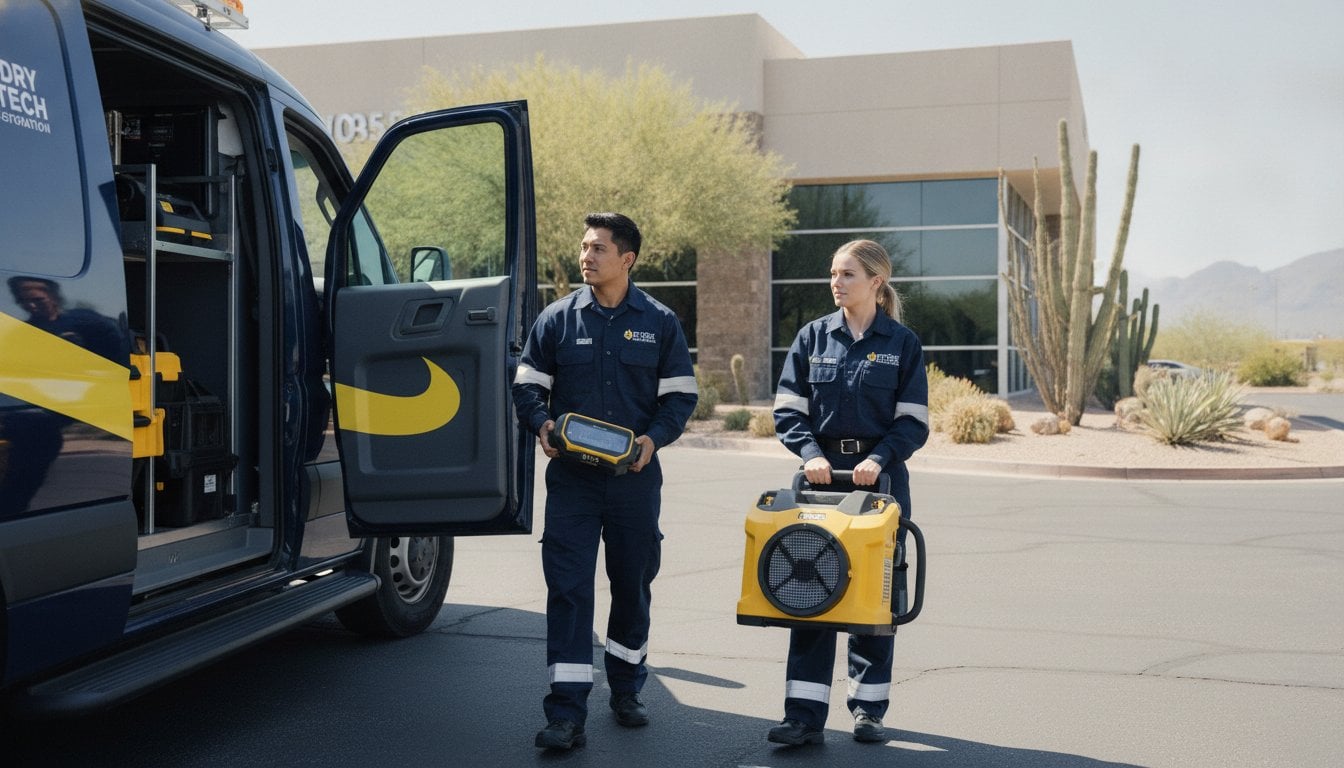
Professional remediation acts as a stabilizing force for your home. While a DIY attempt focuses on surface aesthetics, expert handling addresses the microscopic environment. We utilize industrial-grade technology like HEPA air scrubbers and negative air machines. These tools create a “clean room” environment, capturing 99.97% of particles as small as 0.3 microns. This level of precision is impossible with household fans or retail vacuums. By scrubbing the air, we prevent the “secondary bloom” common in failed DIY projects.
A critical part of our process is source identification. We don’t just remove the growth; we stop the moisture that caused it. Citing EPA guidelines on mold cleanup, professionals prioritize fixing the water problem first. Without this step, your remediation is temporary. Dryrite Restoration provides a 2-year warranty on mitigation work, offering a level of security that a weekend cleanup cannot match. This warranty serves as your guarantee that the recovery is permanent.
The Remediation Roadmap
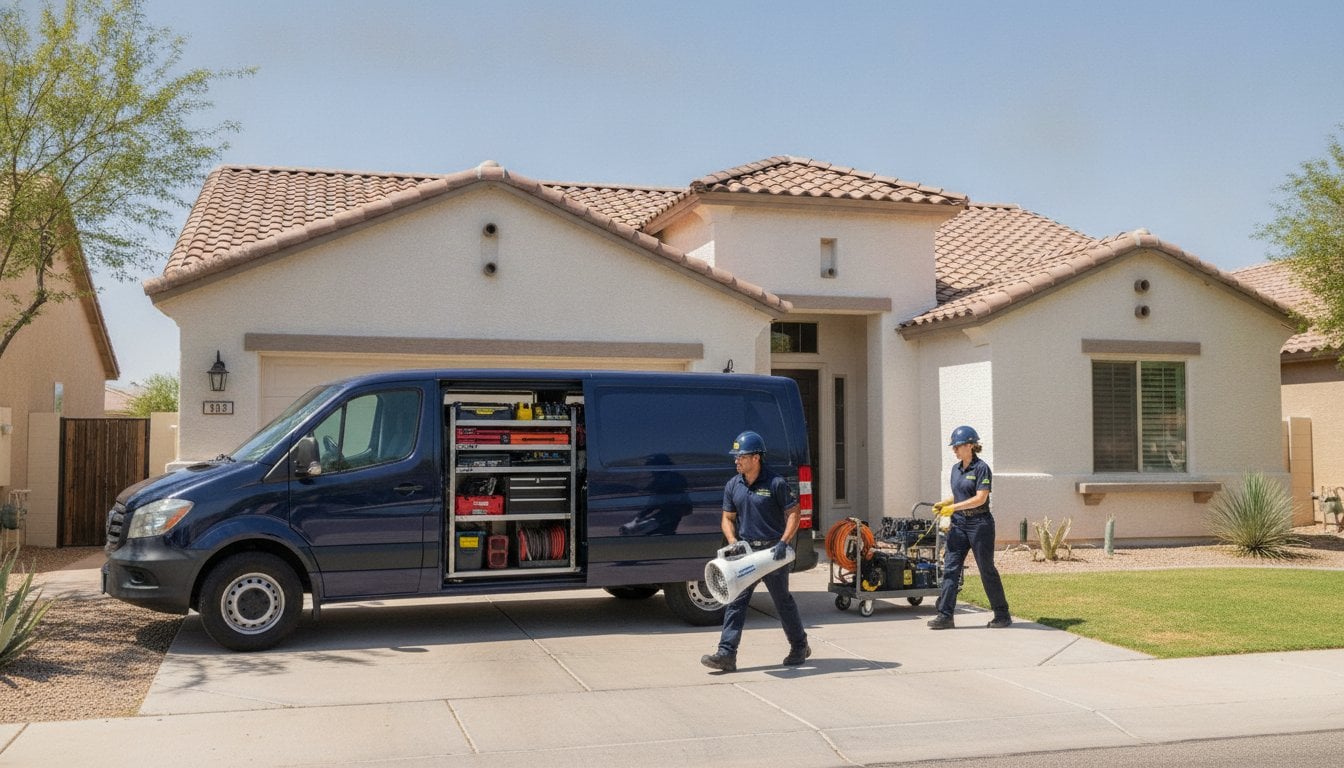
Our team follows a disciplined sequence to bring order to the chaos. This includes strict containment, air filtration, and the removal of compromised materials. Every project for mold remediation in Mesa follows the IICRC S520 standards. This roadmap ensures that every spore is accounted for and neutralized. We conclude with Post-Remediation Verification (PRV). This clearance testing provides the legal proof you need to show your home is safe for occupancy.
DIY vs. Professional Cost-Benefit Table
When weighing DIY vs professional mold remediation Mesa options, consider the long-term impact on your property value. Mesa real estate disclosures require you to report past mold issues. Professional documentation proves the problem was solved correctly, whereas DIY attempts often raise red flags for home inspectors.
| Feature | DIY Approach | Professional Remediation |
|---|---|---|
| Initial Cost | Lower out-of-pocket | Higher investment |
| Risk of Recurrence | High; roots often remain | Guaranteed with 2-year warranty |
| Insurance Support | Rarely covered; high denial risk | Direct coordination and approval |
| Resale Impact | Potential 20-37% value drop | Protects full market value |
Don’t leave your home’s structural integrity to chance. If you suspect hidden growth, contact Dryrite Restoration today for an expert assessment that protects your investment.
Navigating Insurance and Choosing a Mesa Specialist
Dealing with insurance adjusters adds another layer of stress to a mold crisis. Most Arizona homeowner policies include a “Sudden and Accidental” clause. This means coverage usually applies to mold resulting from a burst pipe or a failing water heater. It rarely covers mold caused by slow leaks or poor maintenance. When comparing DIY vs professional mold remediation Mesa strategies, the insurance factor is often the deciding point. Carriers frequently deny DIY claims because homeowners cannot provide the technical documentation required to prove the damage was sudden.
Professional handling changes the dynamic. We provide the moisture maps and thermal imaging reports that adjusters need to approve a claim. Our 90-minute on-site arrival guarantee is a critical trust signal for insurance companies. It proves you took immediate action to mitigate damage, which prevents the “long-term neglect” exclusion. We manage direct insurance company coordination and handle the administrative burden. This direct billing process ensures you can focus on your family’s well-being while we manage the paperwork and the restoration.
Winning Your Insurance Claim
Documentation is the primary currency of a successful recovery. We use advanced moisture mapping to create a digital trail of the contamination. This evidence is vital for getting testing and remediation fees covered. Without professional evidence, you’re left arguing with an adjuster about the severity of the growth. For a deeper look at this process, read our guide on water damage insurance claim help Arizona. This resource explains how to avoid common filing mistakes that lead to denials.
Selecting a Licensed Mesa Contractor
Trust is built on certification and local expertise. Look for a contractor with IICRC certification. This is the gold standard for property recovery. As a family-owned business serving the East Valley since 2004, we understand the specific construction styles and climate challenges of Mesa homes. We don’t use third-party subcontractors; we manage every aspect of your project internally to ensure total accountability. This quiet strength allows us to provide a 2-year warranty on our mitigation work. Don’t risk your home’s safety with uncertified labor. Contact Dryrite Restoration for a professional mold assessment and regain your peace of mind today.
Secure Your Home’s Future with Expert Mold Recovery
Deciding on DIY vs professional mold remediation Mesa homeowners often find challenging depends on one simple factor: the scope of the threat. If you’re facing growth beyond a small, non-porous patch, the risks of cross-contamination and insurance denial are too high to ignore. Professional handling ensures that every spore is contained and the moisture source is permanently neutralized. This is a strategic investment in your family’s respiratory health and your property’s market value.
We provide a stabilizing force during these property crises. Our team offers a 90-minute emergency response in Mesa and Phoenix to catch damage before it escalates. With our 2-year warranty on all mitigation work and direct insurance billing specialists, we bring order back to your home without the administrative friction. Don’t let a minor leak become a structural disaster.
Don’t Risk Your Health – Get a Professional Mold Assessment from Dryrite Restoration. You have the power to stop the spread and restore your peace of mind. We are ready to help you navigate this recovery with confidence and expert care.
Frequently Asked Questions
Can I use bleach to kill mold on drywall in my Mesa home?
No, you should never use bleach to treat mold on porous drywall. Bleach is effective only on non-porous surfaces like tile or glass. Drywall absorbs the water content in bleach, which actually feeds the mold roots deep inside the material. While the surface might look clean temporarily, the fungus will likely return within days. For porous materials, the only safe solution is professional removal and structural drying to ensure the infestation is gone.
How much mold can I safely clean myself before it becomes dangerous?
You can safely handle mold cleanup yourself if the total area is less than 10 square feet on hard, non-porous surfaces. This is roughly the size of a three-foot-by-three-foot patch. When weighing DIY vs professional mold remediation Mesa safety standards, remember that disturbing larger areas without industrial containment releases millions of spores into your air. If the growth covers multiple patches or has entered your wall cavities, you need professional-grade HEPA filtration.
Does Arizona homeowners insurance cover mold remediation costs?
Arizona policies typically cover remediation only if the mold is the direct result of a sudden and accidental covered peril, such as a burst pipe. Insurance companies generally exclude mold caused by long-term humidity, slow leaks, or poor maintenance. To secure a successful claim, you must provide professional documentation and moisture mapping. We specialize in direct insurance coordination, providing the technical evidence adjusters require to approve your mitigation and repair costs quickly.
How long does professional mold remediation take compared to DIY?
Professional remediation usually takes between three to five days to complete. This timeline includes the setup of containment zones, 24 to 48 hours of industrial-grade dehumidification, and final air scrubbing. A DIY attempt might seem faster, but it often fails to address hidden moisture pockets. This leads to recurring growth that forces you to restart the process weeks later. Professional intervention solves the problem permanently in one disciplined, warrantied work cycle.
What are the signs that a DIY mold cleanup has failed?
Persistent musty odors are the primary indicator that a DIY cleanup was unsuccessful. If the smell remains after you have finished scrubbing, active colonies are likely thriving behind baseboards or inside your HVAC ducts. Other red flags include visible regrowth within 10 days or family members experiencing recurring respiratory issues. These signs mean the moisture source was never fully stopped. Immediate professional intervention is required to prevent these hidden spores from causing structural rot.
Is a mold inspection necessary before choosing between DIY and a pro?
A professional inspection is essential if you suspect hidden growth or are navigating the DIY vs professional mold remediation Mesa choice during a home sale. Inspections use thermal imaging and air sampling to detect spores invisible to the human eye. This data-driven approach prevents you from underestimating a hazardous situation. It provides the legal proof and technical roadmap needed to either proceed with a safe cleanup or initiate a full-scale professional decontamination.