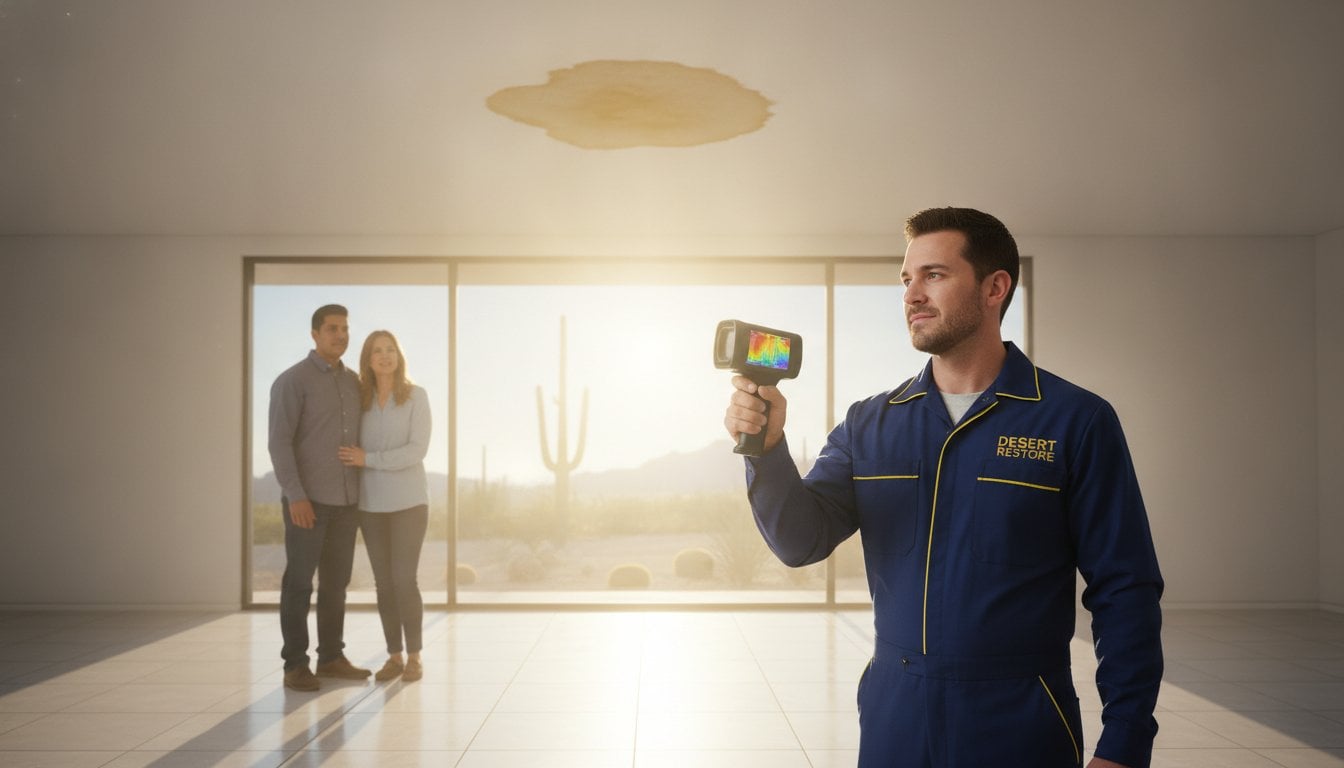
Did you know that a single phrase in your policy could turn a major restoration project into a total out-of-pocket loss? For many homeowners, the “slow and repeated seepage” exclusion is a hidden trap that leads to immediate claim denial. You’re already facing the chaos of property destruction; you shouldn’t have to fight an uphill battle against complex insurance regulations alone. Finding expert water damage insurance claim help arizona is the most critical step you can take to bring order to this crisis.
We understand the pressure you’re under. It’s frustrating to watch your home suffer while worrying if your insurer will actually follow through. This guide will help you master the complexities of Arizona claims and show you how professional documentation prevents the most common denials. We’ll preview the impact of 2026 legislative updates like SB1206 and explain your rights under A.R.S. 12-548. You’ll learn exactly how to secure a successful claim approval and restore your property to its pre-loss condition while minimizing your out-of-pocket expenses.
Key Takeaways
- Identify the difference between “sudden and accidental” leaks and maintenance issues to ensure your policy actually covers the damage.
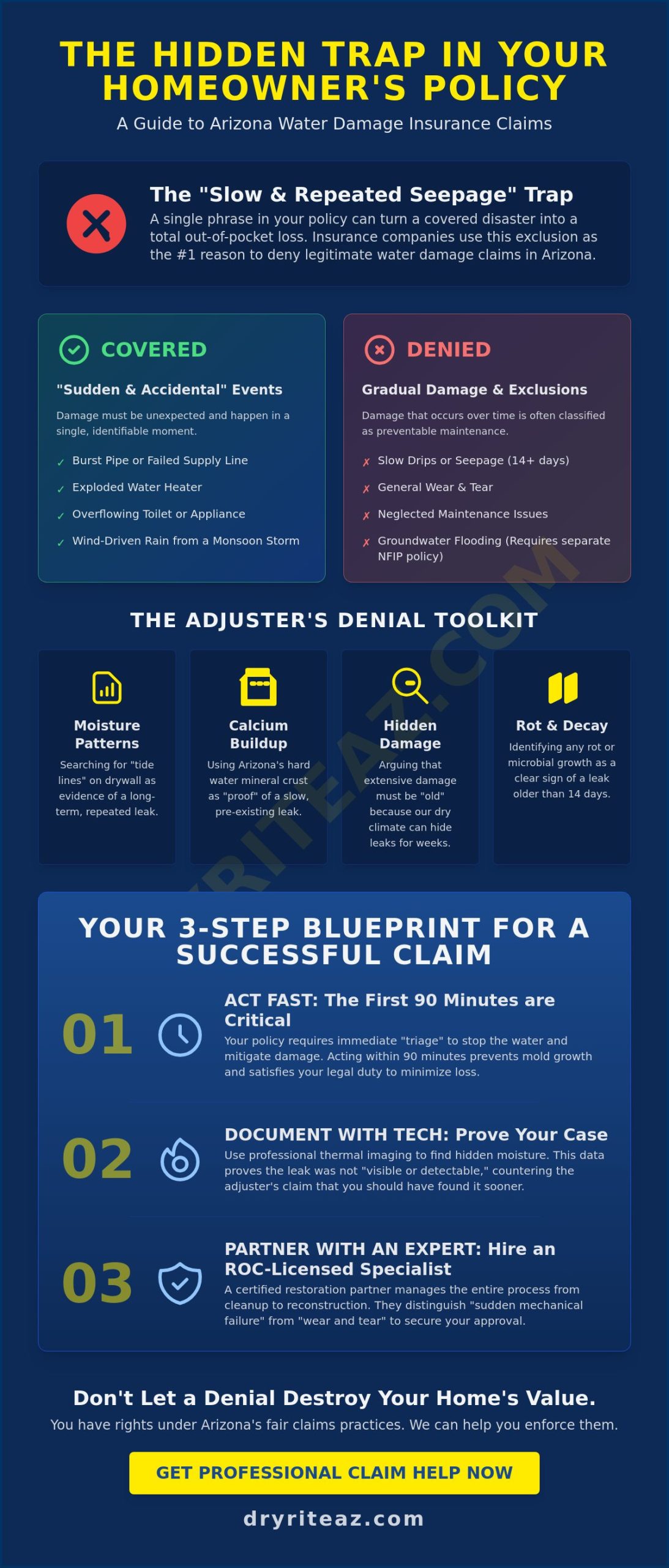
- Avoid the “slow and repeated seepage” trap by understanding how insurance adjusters use moisture patterns to deny legitimate claims.
- Secure professional water damage insurance claim help arizona to document hidden wall cavity moisture using advanced thermal imaging technology.
- Act within the 90-minute mitigation window to prevent mold growth and satisfy your legal obligation to minimize property loss.
- Partner with an ROC-licensed specialist who manages the entire process from initial cleanup to final reconstruction for a seamless recovery.
Understanding Arizona Water Damage Insurance: Covered vs. Excluded
Your recovery depends on one specific phrase used by the Arizona Department of Insurance (DIFI): “sudden and accidental.” In the context of a standard homeowner’s insurance policy, this means the damage must be unexpected and happen in an instant. A water heater that explodes at midnight is sudden. A pipe that bursts under your kitchen sink is accidental. These events are the foundation of a successful claim. When disaster strikes, securing expert water damage insurance claim help arizona ensures you interpret these policy limits correctly before the adjuster arrives.
Most Arizona policies cover common household disasters. This includes failed supply lines, overflowing toilets, and even the intense wind-driven rain from a July monsoon storm surge. However, coverage has strict boundaries. Standard policies never include “flood” damage, which DIFI defines as water rising from the ground up. For that, you need a separate policy through FEMA or the National Flood Insurance Program (NFIP). Intentional acts or gross neglect are also universal exclusions that will lead to an immediate denial of your claim.
Sudden vs. Gradual Damage in Arizona
Insurance companies look for any reason to classify a loss as “gradual.” In Arizona, our high mineral content creates significant hard water buildup. Adjusters often point to calcium deposits on a fitting as evidence that a leak has been “seeping” for months. If they can prove the damage happened over time rather than in a single moment, they will deny the claim under a wear and tear exclusion. You must identify a specific date of loss. Pinpointing the exact moment the failure occurred is the only way to counter the argument that you simply failed to maintain your plumbing.
The Importance of the DIFI Regulatory Framework
You have protected rights under Arizona’s fair claims settlement practices. These regulations prevent insurers from dragging their feet or offering lowball settlements without justification. Your first responsibility under almost every policy is “triage.” You are legally required to take immediate action to stop the water and prevent further destruction. If you wait 48 hours to call for help, the insurance company may refuse to pay for the resulting mold growth. While the Arizona Registrar of Contractors (ROC) oversees the quality of the repair work, your policy dictates the speed of your initial response. Act fast to protect your property and your right to a full payout.
The “Slow and Repeated Seepage” Trap: Why Arizona Claims Get Denied
Claim denial is the greatest fear for any homeowner facing a flooded kitchen or a saturated wall. In the Phoenix Valley, the most common reason for these denials is the “slow and repeated seepage” clause. Insurance adjusters are trained to look for signs that a leak has existed for 14 days or longer. They examine moisture patterns, looking for rot or specific “tide lines” on the back of your drywall. If they find these markers, they will argue the damage was preventable through routine maintenance. This is why expert water damage insurance claim help arizona is essential for homeowners who need to prove their loss was actually sudden.
Arizona’s extremely dry climate creates a unique challenge for these claims. Because our air is so arid, surface moisture often evaporates before you ever see a puddle or a stain. A pipe can fail inside a wall cavity and remain completely hidden until structural damage occurs. When you finally discover the mess, the adjuster may point to the extent of the damage as proof that it’s an “old” leak. You didn’t see it, so how can they say it’s old? Our strategy focuses on proving that the leak was not “visible or detectable” to a reasonable person. We use technical data to show that while the damage is extensive, the failure itself was a single, sudden event. Professional thermal imaging leak detection phoenix services are critical for identifying these invisible failures and establishing the true timeline of a loss.
Hidden Plumbing Leaks and Hard Water Factors
Hard water is a constant reality in Mesa, Phoenix, and surrounding cities. High mineral content leads to significant calcium buildup inside your plumbing fixtures. This “crust” can cause a valve or supply line to fail in an instant. Unfortunately, an adjuster might see that white mineral buildup and immediately classify it as long term deterioration. We distinguish between “wear and tear” and “sudden mechanical failure” by performing structural integrity tests. We prove that the mineral buildup didn’t cause a slow drip; it caused a sudden break that saturated your home in minutes. If you’ve received a denial based on these factors, you need a professional evaluation to fight back with facts.
Challenging an Adjuster’s Denial
When navigating the Arizona insurance claim process, you’ll likely encounter adjusters who specialize in finding reasons to minimize payouts. Common red flags in a denial letter include vague language about “gradual seepage” without providing technical moisture readings to back it up. You have the right to a second opinion from a licensed restoration professional. We provide the technical data, including moisture maps and atmospheric readings, that can overturn a “wear and tear” classification. Don’t let an insurance company’s first word be the final word on your home’s recovery.
The Documentation Blueprint: Proving Your Claim with Tech
Most homeowners believe a smartphone gallery full of photos is enough to secure a payout. It isn’t. While visual evidence helps, insurance adjusters require scientific data to approve high-value claims. In our arid environment, surface water disappears quickly while structural materials remain dangerously saturated. Professional water damage insurance claim help arizona hinges on technical documentation that proves the extent of the loss before the environment changes. We don’t just take pictures; we build a forensic file that makes it impossible for an insurer to ignore the reality of your situation.
This documentation acts as your shield during the recovery process. It turns a subjective argument about what “looks” wet into an objective fact. By recording the atmospheric conditions of your home from the moment we arrive, we establish a baseline that prevents adjusters from claiming the damage existed prior to the loss. This level of precision is the difference between a denied claim and a property restored to pre-loss condition.
Thermal Imaging and Leak Detection
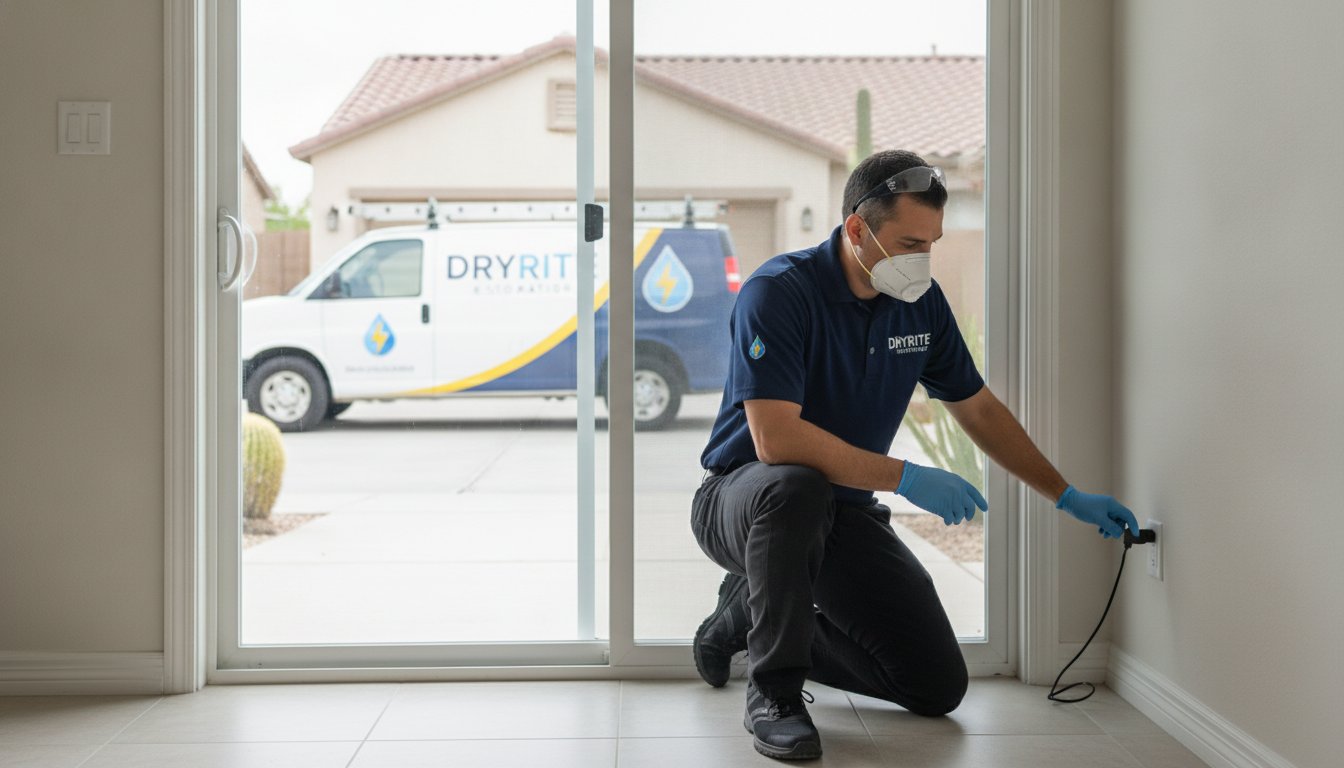
Infrared cameras are the gold standard for modern restoration. These tools detect temperature variances that indicate active moisture behind finished surfaces like drywall or cabinetry. If a pipe bursts in a second floor bathroom, water often travels through floor joists and down interior wall cavities. An adjuster might only see the ceiling stain, but thermal imaging leak detection phoenix professionals use to reveal the entire migration path. By creating a visual heat map, we document exactly where the water traveled. This prevents the insurance company from “spot cleaning” a single area while leaving hidden moisture to rot your home’s skeleton.
Moisture Meters and Structural Records
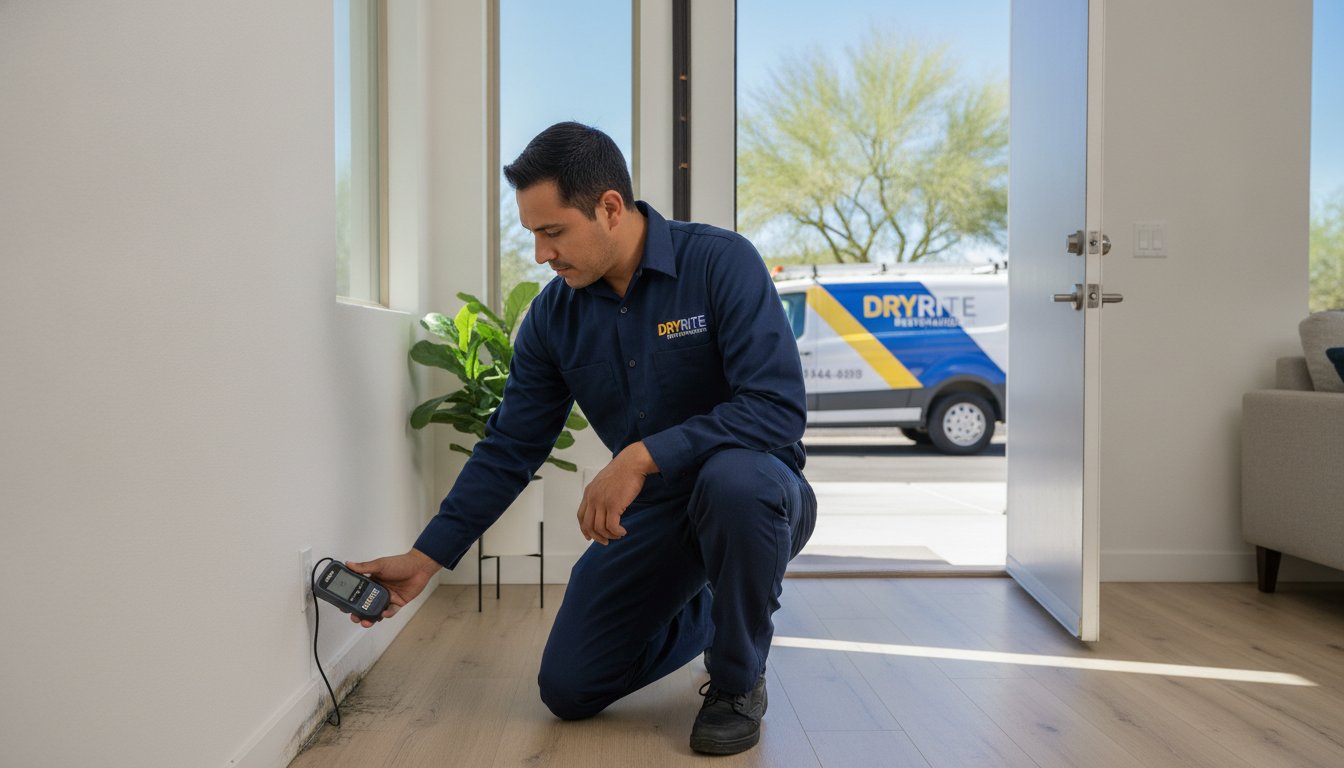
There is a massive difference between “dry to the touch” and “dry to the standard.” Drywall may feel like bone dry paper on the outside while the gypsum core remains at 90% saturation. We use specialized moisture meters to create a scientific record of the dry-down process. These readings are compiled into daily psychrometric logs, which track temperature, humidity, and vapor pressure. This data proves the structural drying is effective. More importantly, we link this restoration data directly to Xactimate, the same software insurance companies use to calculate payouts. This alignment of data reduces administrative friction and speeds up your approval.
Navigating the Arizona Insurance Claim Process Step-by-Step
Your recovery depends on a series of fast, calculated moves. In the Phoenix Valley, the clock starts the second water touches your floor. Following a structured path ensures you don’t miss critical deadlines or lose out on thousands in coverage. If you need water damage insurance claim help arizona, understanding these five steps will keep you in control of the process. We act as a stabilizing force, guiding you from the initial chaos to a fully restored home.
- Step 1: Immediate Mitigation. Stop the water source and begin extraction within the first 90 minutes to prevent secondary damage.
- Step 2: Filing the Claim. Contact your carrier immediately to obtain a claim number. This starts the official clock on your recovery.
- Step 3: The Inspection. An adjuster will visit your property to verify the cause of loss and estimate the cost of repairs.
- Step 4: Approval and Scope of Work. Once the claim is approved, you must agree on a detailed list of every repair needed to reach pre-loss condition.
- Step 5: Final Reconstruction. After repairs are finished, you’ll sign a certificate of completion to release the final insurance funds.
The First 24 Hours: Mitigation vs. Repair
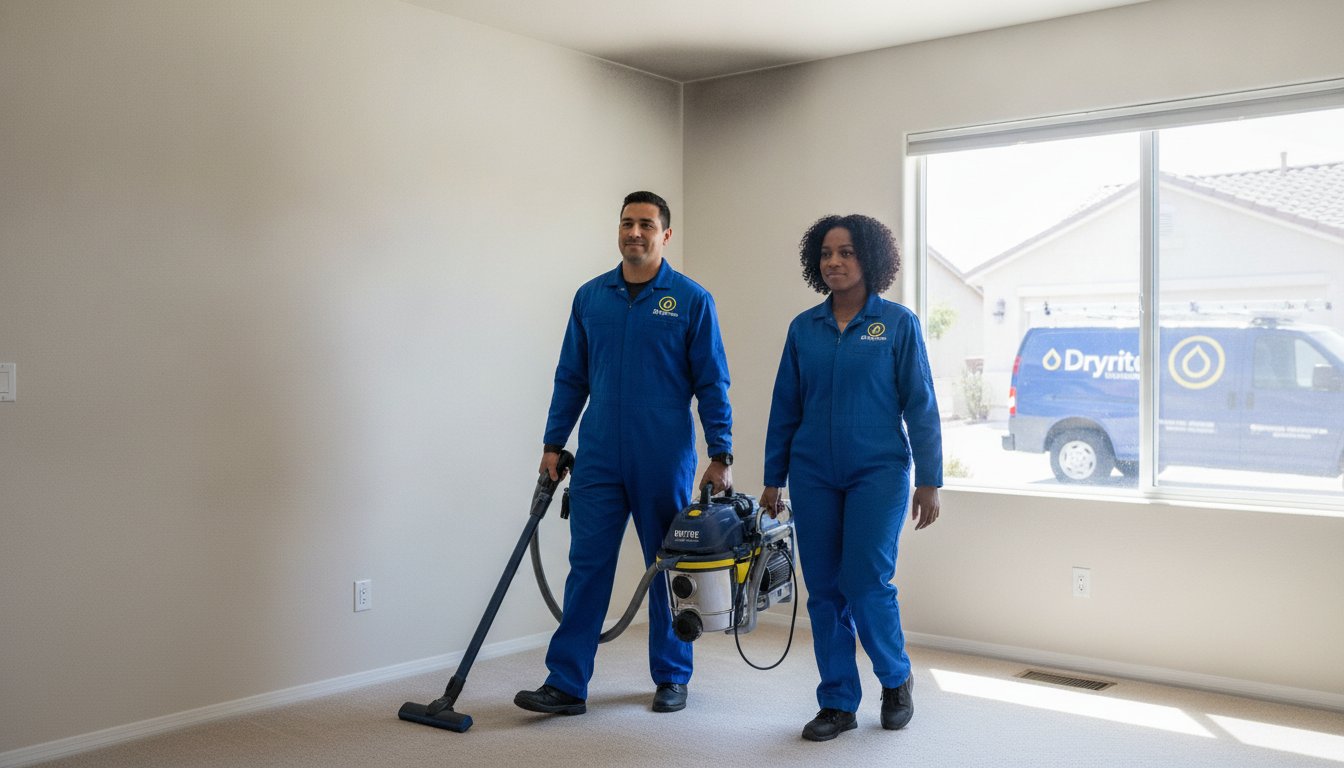
You shouldn’t wait for an insurance adjuster to arrive before you start water extraction. Most policies legally require you to mitigate the damage immediately. If you leave standing water on your floors for two days, the insurer may deny the resulting mold growth as “preventable.” We focus on the 90-minute rule because immediate action saves thousands in structural costs. Documenting the property with photos and moisture readings before and after mitigation is the only way to protect your payout. This evidence proves you fulfilled your duty to protect the property. When every minute counts, 24/7 water damage repair Mesa residents can access ensures your home gets the rapid response it needs before destruction becomes permanent.
Managing the Adjuster Meeting
Never walk through an inspection alone. Your restoration contractor should be present during the adjuster’s visit to ensure no damage is overlooked. Adjusters often face “preferred vendor” pressure from their employers to minimize costs. We act as your Experienced Protector, pointing out hidden risks like mold in wall cavities or asbestos in older Arizona flooring. By ensuring the “Scope of Work” is comprehensive from day one, we prevent the need for stressful supplements later in the project. If you’re currently facing a property crisis, contact us for professional reconstruction services to ensure your home is rebuilt correctly the first time.
Why Choosing a Certified Arizona Restoration Partner Matters
A water loss is more than a physical mess; it’s a logistical nightmare. Many homeowners make the mistake of hiring separate companies for extraction and reconstruction. This fragmented approach leads to communication gaps that insurance adjusters often exploit to delay payments. Choosing a “one-stop shop” ensures a seamless transition from the initial cleanup to the final coat of paint. When you secure water damage insurance claim help arizona from a full-service partner, you eliminate the friction of managing multiple vendors during a crisis.
Accountability is the foundation of a successful recovery. In our state, holding a valid license from the Arizona Registrar of Contractors (ROC) is non-negotiable for insurance-related reconstruction. This certification guarantees that the work meets strict building codes and protects your property value. We further stabilize the situation by offering direct insurance billing. Instead of you acting as a middleman between the bank and the contractor, we handle the administrative heavy lifting. This keeps your focus on your family while we manage the paperwork. We also provide a 2-year warranty on our mitigation work, ensuring your peace of mind lasts long after the fans are removed.
Local Expertise in Mesa and the Phoenix Valley
Arizona homes are built to withstand the desert, but they require specific knowledge when water strikes. From post-tension slabs to specific stucco applications, we understand the materials used in our community. Our local climate also creates a high-stakes environment for biological growth. The intense heat in Mesa and the Phoenix Valley can turn a small leak into a major health hazard in less than 48 hours. This makes specialized Professional Mold Remediation Mesa AZ essential for any water claim. We use our deep understanding of local building codes to ensure your home isn’t just dry, but safe and compliant. Water damage in older Mesa properties can also disturb hazardous building materials, making professional asbestos removal Mesa AZ a critical safety consideration during any restoration project.
The Experienced Protector Advantage
We see ourselves as more than a service provider; we are your Experienced Protector. The insurance process is often adversarial, but our presence acts as a stabilizing force that brings order to the chaos. We prioritize transparent, organized communication with your adjuster to ensure every technical detail is documented and approved. This disciplined approach prevents the communication gaps that lead to claim denials or lowball settlements. You don’t have to navigate this turmoil alone. Contact Dryrite Restoration 24/7 for expert claim assistance and let our team restore your property and your tranquility.
Secure Your Home’s Future Today
You now have the tools to navigate the complex world of insurance claims with confidence. Success depends on acting quickly and documenting every technical detail before the environment changes. By identifying the “sudden and accidental” nature of your loss and utilizing advanced thermal imaging, you can prevent common denials and ensure your property is restored to its pre-loss condition. Expert water damage insurance claim help arizona is just a phone call away; providing the stabilizing force you need during a crisis.
We stand ready to protect your interests with a 24/7 emergency response that arrives within 90 minutes. Our team is fully licensed through the Arizona ROC and provides a 2-year warranty on all mitigation work to ensure your peace of mind lasts. Get 24/7 Expert Help with Your Water Damage Claim and move from turmoil to tranquility. Your home is your most valuable asset; let’s make sure it’s handled with the expert care it deserves.
Frequently Asked Questions
Does home insurance cover water damage from a burst pipe in Arizona?
Yes, standard policies cover water damage from burst pipes because they are classified as sudden and accidental. This coverage includes the cost of water extraction and structural drying, though it rarely pays for the plumbing repair itself. You must act quickly to stop the water flow to remain compliant with your policy’s mitigation requirements. Immediate action prevents secondary damage that could lead to a partial claim denial.
What is the “slow and repeated seepage” exclusion in my policy?
This exclusion denies coverage for damage that occurs gradually over a period of 14 days or longer. Adjusters look for specific markers like rot, rust, or tide lines on drywall to prove the leak was ongoing. This is why securing professional water damage insurance claim help arizona is vital. Technical documentation can prove your loss was a single, sudden event rather than a long-term maintenance issue.
Can I choose my own restoration company in Arizona, or must I use the insurance company’s vendor?
You have the legal right to choose your own restoration contractor; you are not required to use the insurance company’s preferred vendor. While insurers often push their own network to control costs, hiring an independent, ROC-licensed specialist ensures your home is restored to your standards. Always verify a contractor’s license with the Arizona Registrar of Contractors to ensure they are qualified for insurance-related reconstruction work.
How long do I have to file a water damage claim in Arizona?
Arizona law A.R.S. 12-548 allows up to 6 years to sue for breach of contract, but most insurance policies shorten the claim filing window to just one year. You should report the loss immediately to avoid “late reporting” denials. Review your specific policy declarations page to confirm the exact deadline. Waiting too long allows the insurer to argue that the damage worsened due to your delay.
What should I do if my water damage claim is denied?
Start by reviewing the formal denial letter to identify the specific policy exclusion cited by the adjuster. You should immediately gather technical evidence, such as thermal imaging reports or moisture maps, to challenge their findings. If the dispute continues, you can file a complaint with the Arizona Department of Insurance and Financial Institutions (DIFI) or hire a licensed public adjuster to represent your interests.
Does insurance cover mold remediation after a water leak?
Coverage for mold depends on whether the growth resulted from a covered water peril and the specific limits in your policy. Many Arizona policies include a mold sublimit, often capped at $5,000 or $10,000, which may not cover extensive remediation. Check your policy for an “Optional Mold Coverage” endorsement. This is especially important during the humid monsoon season when mold can trigger within 48 hours.
Will my insurance premiums go up if I file a water damage claim?
Filing a claim can lead to a premium increase or the loss of a “claims-free” discount, but this isn’t guaranteed for a single, no-fault event. Insurance companies primarily track the frequency of claims rather than just the dollar amount of one loss. If your home has a history of multiple water losses, the carrier may view the property as a higher risk during your next renewal period.
How does hard water affect my plumbing insurance coverage?
Hard water is frequently cited by adjusters as evidence of “wear and tear” to justify a claim denial. High mineral content in the Phoenix Valley causes calcium buildup that can lead to sudden fixture failure. We provide the technical proof needed to show that while buildup exists, the actual failure was an unexpected, sudden mechanical break. This distinction is critical for overturning denials based on “lack of maintenance” arguments. When water damage restoration uncovers older building materials during repairs, homeowners should also be aware of the need for safe asbestos removal Mesa AZ professionals to handle any hazardous materials discovered during the reconstruction process.